
Monday, November 07, 2011


Wednesday, November 02, 2011
Simone Forti at Roulette - Oct 28, 2011
SIMONE FORTI, an evening of Movement, Sound and Spoken Word
: Walking the Forest - with "molimo" horn
: Sleepwakers
: Striding Crawling - with Claire Filmon
: Reading/The Bear in the Mirror
:News Animation - with Batyah Schachter

 striding pausing retreating
proclaiming gestures as a moving painting
old lady spirit falling in little ways
releasing to the dream of gravity
the political act of rolling on the floor
smushing one's nose into the ground
rolling the spiral
roulette is a new space
an open square
pregnant balcony
squaring its audience in the round
doing what one does
walking among the ribbits
 crawling evolving devolving
to hands and knees
simplicity soundscore
the hippies among us = dancers
that counter culture - contact lions rough-housing among the frogs
stage as pond
all natural movement - horses, birds
literal child's play
in contrast to the freedom of abstraction


memories of escaping Italy in 1938 Jewish Italian chosen
Palestine ---> OWS, the european crisis
takes for granted the kindness of her life
"the money is making it that there's less and less stuff"
an email from a Japanese teacher who said they were told to stay in doors was the chance for him to stay home and paint and he was keeping the windows open
"it's different to read his email than articles"
dipping into the well of thoughts, imagination
in Vermont where there's not much money there is more bartering, more fresh fruits and vegetables
and when the plumbing backs up which it will if you live in VT, someone shows up in a week and you offer them tea and ask how their kids are doing and they fix your plumbing because this is the plumber.
"That's the solo." A bag of potatoes drops to the floor.
Her skin tells her a lot of things.
Where do we go from here?
And what if you just wonder about the universe on your own, without religion?
The Israeli says that's impossible. In Israel, they want to know what is your authority.
: Walking the Forest - with "molimo" horn
: Sleepwakers
: Striding Crawling - with Claire Filmon
: Reading/The Bear in the Mirror
:News Animation - with Batyah Schachter

sea shell song of plumbing pipe
an anne morrow lindbergh of dance
the elegant shaking wonder
a poem of singular tone

proclaiming gestures as a moving painting
old lady spirit falling in little ways
releasing to the dream of gravity
the political act of rolling on the floor
smushing one's nose into the ground
rolling the spiral
roulette is a new space
an open square
pregnant balcony
squaring its audience in the round
doing what one does
walking among the ribbits

to hands and knees
simplicity soundscore
the hippies among us = dancers
that counter culture - contact lions rough-housing among the frogs
stage as pond
all natural movement - horses, birds
literal child's play
in contrast to the freedom of abstraction


memories of escaping Italy in 1938 Jewish Italian chosen
Palestine ---> OWS, the european crisis
takes for granted the kindness of her life
"the money is making it that there's less and less stuff"
an email from a Japanese teacher who said they were told to stay in doors was the chance for him to stay home and paint and he was keeping the windows open
"it's different to read his email than articles"
dipping into the well of thoughts, imagination
in Vermont where there's not much money there is more bartering, more fresh fruits and vegetables
and when the plumbing backs up which it will if you live in VT, someone shows up in a week and you offer them tea and ask how their kids are doing and they fix your plumbing because this is the plumber.
"That's the solo." A bag of potatoes drops to the floor.
Her skin tells her a lot of things.
Where do we go from here?
And what if you just wonder about the universe on your own, without religion?
The Israeli says that's impossible. In Israel, they want to know what is your authority.
Monday, October 24, 2011

Wednesday, October 19, 2011

Sunday, October 16, 2011
the spirit of the times
Levis Jeans trying to horn in on the protest spirit of the times.... nice try Levis.
 |
| Times Square, Oct 15, 2011 - c. topiphone |
Friday, October 14, 2011
eco disaster style?
Not sure why this would make it on the Washington Post Style tumblr.... sign of the times?
Found this image on the Washington Post Style website:

Photo by Christophe Archambault / Getty
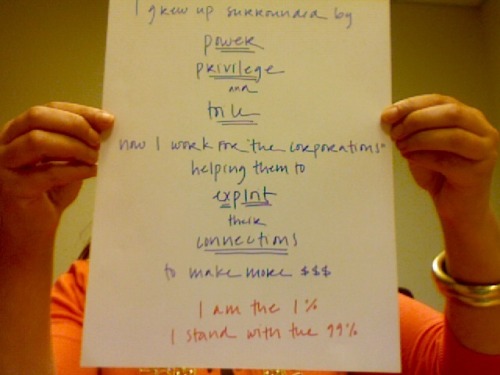
We are the 1% Tumblr website
Collection of recipients of wealth, privledge and entitlement who want to see things become more equitable and be taxed more!
We are the 1% Tumblr

We are the 1% Tumblr
Wednesday, October 12, 2011
Mike Daisey's: Steve Jobs, Enemy of Nostalgia
Mike Daisey's frank and right-on analysis of the Steve Jobs legacy and the real work that Apple should be doing.
OP-ED CONTRIBUTOR
Against Nostalgia
 |
| Jason Polan |
By MIKE DAISEY
Published: October 6, 2011
Published: October 6, 2011

Tuesday, October 11, 2011

Monday, October 10, 2011
Thursday, October 06, 2011
A computer is a bicycle for the mind.
"Stay hungry, stay foolish." Steve Job's beautiful Stanford University 2005 commencement address:

Monday, October 03, 2011
Paul Krugman's metaphor of choice
October 2, 2011, 8:03 PM
This is the equivalent of putting explosives into a can, before kicking it down the road.
Saturday, October 01, 2011

Thursday, September 29, 2011

Wednesday, September 28, 2011
Tim O'Reilly's "Birth of the Global Mind" article
reposted from FT Magazine blog, Sept 23, 2011
 Computer scientist Danny Hillis once remarked, “Global consciousness is that thing responsible for deciding that pots containing decaffeinated coffee should be orange.” And of course, the mechanism by which the Sanka brand colour became a near-universal symbol for decaffeinated coffee in the US is exactly the same one by which hundreds of millions of people have a shared knowledge of Lady Gaga, Newton, Einstein and Darwin, and, for that matter, of many things both true and untrue.
Birth of the global mind
The best symbiosis of man and computer is where a program learns from humans but notices things they would not
Global consciousness. We’ve heard that before. In the 1960s we were all going to be mystically connected; or it would come as a super-intelligent machine – Terminator’s Skynet – that is inimical to humanity. And yet, what if the reality is more mundane?
Computer scientist Danny Hillis once remarked, “Global consciousness is that thing responsible for deciding that pots containing decaffeinated coffee should be orange.” And of course, the mechanism by which the Sanka brand colour became a near-universal symbol for decaffeinated coffee in the US is exactly the same one by which hundreds of millions of people have a shared knowledge of Lady Gaga, Newton, Einstein and Darwin, and, for that matter, of many things both true and untrue. What is different today, though, is the speed with which knowledge propagates. News, entertainment and opinions spread through social networks, websites and search engines in a process increasingly close to real-time. Those things that rise to the top are decided not by media executives but by their viral momentum.
One might say that this is the same underlying mechanism of human knowledge capture and retransmission that has always driven the advance of civilisation. But just as the spread of literacy and the printed book led us into the modern era, the even greater capability for knowledge transmission and recall using electronic networks is propelling us towards a very different future.
The web is a perfect example of what engineer and early computer scientist Vannevar Bush called “intelligence augmentation” by computers, in his 1945 article “As We May Think” in The Atlantic. He described a future in which human ability to follow an associative knowledge trail would be enabled by a device he called “the memex”. This would improve on human memory in the precision of its recall. Google is today’s ultimate memex.
The web also demonstrates what JCR Licklider, another early computer visionary, called “man-machine symbiosis”. Humans create the documents that make up the web and provide the associative links between them. Search engines follow our breadcrumb trail, evaluate the strongest paths, and lead others to what has been found. When the algorithms for finding the “right” documents improve, we all get smarter; when spammers or other malware lead the algorithms astray, we all get dumber.
Man-machine symbiosis isn’t just about knowledge retrieval, it’s also about knowledge creation. Our computers have no intelligence without us, but they accelerate our collective intelligence at a speed that has never been seen before.
When the web goes mobile, even more interesting things start to happen. A human with a smartphone can literally see around corners and through time. What’s more, our phones are eyes and ears for what is starting to look increasingly like a global brain. Photos are automatically uploaded to vast cloud databases, each one tagged with its location and the time it was taken. Applications like Shazam can listen to a song and tell you who is singing it. The ambient sound of a room can be used to pinpoint your location.
To understand where the combination of mobile sensors, cloud databases and computer algorithms augmented by human action is leading us, consider the self-driving car. Stanley, a driverless vehicle, won the US Darpa (Defense Advanced Research Projects Agency) grand challenge in 2005 by navigating a course of slightly over seven miles in a little under seven hours. Last year, Google demonstrated an autonomous vehicle that has driven over 100,000 miles in ordinary traffic. The difference: Stanley used traditional artificial intelligence algorithms and techniques; the Google autonomous vehicle is augmented with the memory of millions of road miles put in by human drivers building the Google Street View database. Those cars recorded countless details – the location of stop signs, obstacles, even the road surface.
This is man-computer symbiosis at its best, where the computer program learns from the activity of human teachers, and its sensors notice and remember things the humans themselves would not. This is the future: massive amounts of data created by people, stored in cloud applications that use smart algorithms to extract meaning from it, feeding back results to those people on mobile devices, gradually giving way to applications that emulate what they have learned from the feedback loops between those people and their devices.
In the best case, we see a creative symbiosis of man and machine. However, it’s easy to get the balance wrong: we have only to look at the financial market excesses of the past decade to see the danger of algorithms gone wild in the hands of rogue companies and individuals seeking only their own advantage.
The global brain is still in its infancy. We can raise it to help us make a better world, or we can raise it to be selfish, unjust and short-term in its outlook.
Author and designer Edwin Schlossberg once said, “The skill of writing is to create a context in which other people can think.” This is a good time to think hard about the future. It’s increasingly in the hands of computers that magnify the effectiveness – and the choices – of those who use them; the great challenge of the 21st century will be to teach them the difference between right and wrong.
Tim O’Reilly is the founder and CEO of O’Reilly Media
Tuesday, August 30, 2011

Monday, July 18, 2011

Thursday, July 07, 2011

Subscribe to:
Posts (Atom)